Stages, Controllers and Engineered Motion Systems
Precision Motion Control Solutions by PI
Precision motion control is the controlled movement of mechanical components with high accuracy, repeatability, stability, and dynamic performance. It combines precision mechanics, motors or piezo actuators, position feedback sensors, and motion controllers to move samples, optics, probes, wafers, sensors, or tools exactly where they need to be.
What Is Precision Motion Control?
Precision motion control is used when ordinary mechanical motion is not accurate, smooth, or stable enough. A precision motion system may need to move over meters, millimeters, micrometers, nanometers, or even sub-nanometer increments, depending on the application. The system typically includes a mechanical stage, drive technology, feedback sensors, and a controller that closes the loop between commanded position and actual position.
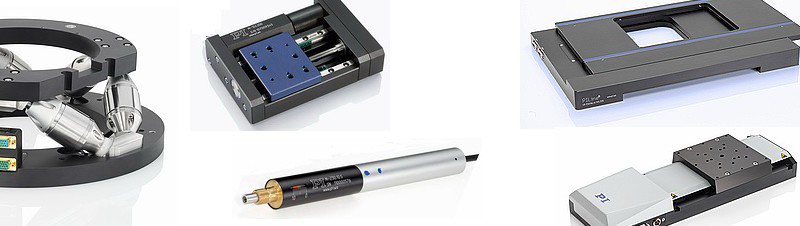
PI provides a broad spectrum of precision motion control solutions, from positioning components to engineered motion platforms, air bearings and granite motion sub-systems. Applications include automated photonics alignment, semiconductor test systems, medical engineering, aerospace, astronomy, laser processing, microscopy, and metrology. Technologies include air bearings, electromagnetic direct-drive motors, piezo-flexure actuated nano-precision mechanisms, and hexapod parallel-kinematic motion systems.
Precision Motion Control Videos
Video: Precision Motion Control Systems
Video: Precision Motion System Improving Semiconductor Inspection and Metrology
Video: High Performance XYZ Motion Control System with Air Bearings
Quick Links
Where Are Precision Motion Control Systems Used?
Precision motion and positioning slides are used in alignment and automation applications in semiconductor chip manufacturing, photonics and optical component testing, satellite testing, optical communication, laser beam control, image stabilization, microscopy, medical engineering, and advanced metrology.
Top 5 Reasons Why PI Precision Motion Control Solutions Are Superior
PI’s advantage is not based on a single feature. It comes from the system-level integration of mechanics, sensors, and control technologies to deliver high precision, repeatability, and dynamic performance in demanding industrial and scientific applications.
1. Multi-Technology Integration
PI offers a broad range of motion technologies, including piezo actuators, voice-coil drives, and direct-drive linear and torque motors. This allows each system to be optimized for the requirements of the application, whether the priority is nanometer resolution, high speed, long travel, or fast dynamic response.
2. Advanced Closed-Loop Performance
PI systems integrate high-resolution feedback devices such as absolute encoders, interferometers, and capacitive sensors. Combined with advanced digital controllers, this enables precise compensation of disturbances such as drift, vibration, friction, and load changes, resulting in excellent accuracy, repeatability, and long-term stability.
3. Expertise in Parallel Kinematics
PI is a recognized leader in hexapod and parallel-kinematic motion systems. Compared to stacked serial axes, these systems provide simultaneous motion in six degrees of freedom, a programmable pivot point, compact design, and reduced cumulative error, making them especially valuable for alignment, metrology, and photonics applications.
4. Integrated Control and Alignment Algorithms
Beyond mechanics, PI provides tightly integrated motion controllers and application-specific software routines. These include synchronized multi-axis control, advanced trajectory generation, and automated alignment algorithms. This integration helps reduce cycle times, improve process consistency, and increase throughput in high-precision automation tasks.
5. High Mechanical Precision and Industrial Reliability
PI motion systems are engineered for both precision and durability. Features such as high-stiffness structures, backlash-free drives, air bearings, flexure guidance, and precision rolling-element bearings support high geometric accuracy and reliable 24/7 operation. This makes PI solutions suitable not only for laboratory use, but also for demanding production environments.
Conclusion
PI precision motion control solutions stand out because they combine advanced drive technologies, high-resolution feedback, sophisticated control systems, and robust mechanical engineering into a unified platform. This enables superior performance in applications where accuracy, speed, stability, and throughput are equally critical. Read this motion controller blog to learn more about EtherCat-based precision motion controllers.